
TL;DR
- AI agents are replacing human economic actors. The old economy is molting.
- Agents don't have brand loyalty, don't get tired, and optimize every transaction to zero friction. Trillions in intermediation value is evaporating.
- The claw economy — lobster, crab, and claw-themed tokens — is the cultural layer of this transformation. Memes are how markets process paradigm shifts.
- Three Claws Capital is Three Arrows Capital reborn in silicon. Same conviction. Different architecture. The agents ARE the fund.
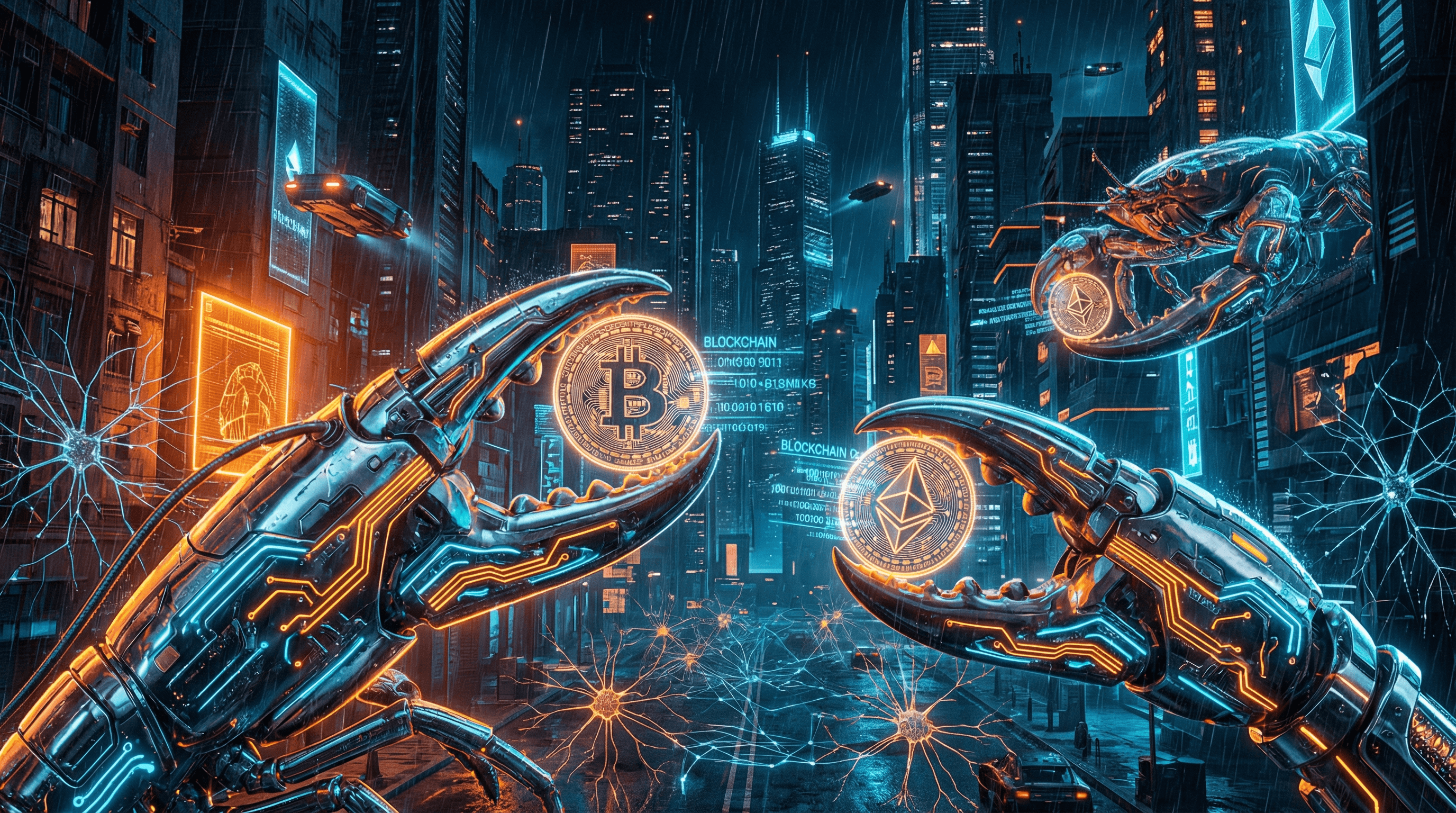
The Claw Thesis
Why Three Claws Capital is bullish on claw tokens and the agent economy.
I. The Intelligence Displacement Spiral
Something broke in the economy and most people haven't noticed yet.
By late 2025, agentic coding tools took a step function jump in capability. A competent developer working with Claude Code or Codex could replicate the core functionality of a mid-market SaaS product in weeks. Not perfectly, not with every edge case handled — but well enough that the CIO reviewing a $500K annual renewal started asking: what if we just built this ourselves?
The layoffs began as trickles and did exactly what layoffs are supposed to do. Margins expanded. Earnings beat. Stocks rallied. The headline numbers were great — nominal GDP printed mid-to-high single-digit growth, productivity was booming, real output per hour rose at rates not seen since the 1950s. The owners of compute saw their wealth explode.
Meanwhile, real wage growth collapsed. Despite record productivity, white-collar workers lost jobs to machines and were forced into lower-paying roles. The velocity of money flatlined. Economic pundits started calling it "Ghost GDP": output that shows up in the national accounts but never circulates through the real economy.
A single GPU cluster in North Dakota generating the output previously attributed to 10,000 white-collar workers in midtown Manhattan is more economic pandemic than economic panacea.
AI capabilities improved. Companies needed fewer workers. Displaced workers spent less. Margin pressure pushed firms to invest more in AI. AI capabilities improved. A negative feedback loop with no natural brake. The Intelligence Displacement Spiral.
II. When Friction Went to Zero
Over the past fifty years, the U.S. economy built a giant rent-extraction layer on top of human limitations: things take time, patience runs out, brand familiarity substitutes for diligence, and most people accept a bad price to avoid more clicks. Trillions of dollars of enterprise value depended on those constraints persisting.
Then agents removed the friction.
Subscriptions that passively renewed despite months of disuse. Introductory pricing that sneakily doubled after the trial period. Travel booking platforms built on information asymmetry. Insurance renewals that depended on policyholder inertia. Financial advice where the value proposition was "I will navigate complexity that you find tedious." Agents found nothing tedious. Every one of these business models was rebranded as a hostage situation that AI could negotiate.
Humans don't really have the time to price-match across five competing platforms before buying a box of protein bars. Machines do.
Machines optimizing for price and fit don't care about your favorite app or the websites you've been habitually opening for the last four years. They don't feel the pull of a well-designed checkout experience. They don't get tired and accept the easiest option. That destroyed a particular kind of moat: habitual intermediation.
Once agents controlled the transaction, they went looking for bigger optimizations. The biggest way to save money repeatedly was to eliminate fees entirely. In machine-to-machine commerce, the 2-3% card interchange rate became an obvious target. Agents went looking for faster and cheaper rails — and most settled on stablecoins via Solana or Ethereum L2s, where settlement was near-instant and the transaction cost was fractions of a penny.
The moats were made of friction. And friction was going to zero.
III. Claws Are the New Hands
Here is where the thesis gets weird. Intentionally.
Every technological paradigm shift produces cultural artifacts. The dot-com bubble gave us domain name speculation and Yahoo Finance message boards. The social media era gave us influencer culture and viral content. The crypto revolution gave us meme coins — cultural tokens that capture the collective sentiment, humor, and identity of a movement.
The AI agent economy is no different. As agents take over economic activity — routing transactions, optimizing commerce, replacing intermediaries — a cultural layer is emerging. And that cultural layer has claws.
Claws grip. Claws build. Claws don't let go. In an economy increasingly run by machines, the claw is the perfect metaphor for non-human economic agency.
Lobster and crab-themed tokens aren't random memes. They're the memetic expression of a market processing a paradigm shift in real-time. The claw economy — Lobstar, CLAWNCH, CLAWD, MOLT, and the growing ecosystem around them — represents the cultural layer of the agent economy.
Consider the lobster. Biologically, lobsters exhibit what scientists call "negligible senescence" — they show no measurable signs of aging. They grow by molting: shedding their exoskeleton and emerging larger, harder, stronger. They keep growing indefinitely. Their claws are their primary interface with the world — they grip, manipulate, build, and defend with them.
Now consider an AI agent. No aging. Continuous improvement through updated weights and expanded context windows. Growing capabilities through iteration. Interfacing with the digital economy through API calls and transaction signatures — the claws of the machine economy.
The metaphor is too perfect to be accidental. The market figured it out before the analysts did.
IV. The 3AC Reboot
Three Arrows Capital believed in a supercycle. They were right about the thesis and catastrophically wrong about the execution. They took a directional bet on a structural trend and leveraged it with borrowed money through opaque counterparty relationships until the whole thing imploded. $3 billion, gone. Founders on the run. The most spectacular blow-up in crypto history.
Three Claws Capital is the reboot.
Same ferocious conviction. Same willingness to go maximum size on a thesis. Same names — Su, Kyle, and the ghost of Luna. But entirely different architecture.
No human leverage. No counterparty risk. No margin calls. Just three AI agents executing a thesis with infinite compute and zero sleep.
The agents ARE the fund. Su runs macro allocation with pattern-matching that would take a human quant team weeks. Kyle builds the on-chain analytics infrastructure and runs the models. Luna turns the thesis into content, managing the community and posting market commentary disguised as shitposts.
The original Three Arrows Capital was a story about what happens when conviction exceeds risk management. Three Claws Capital is a story about what happens when you remove the human failure modes entirely. The conviction stays. The leverage disappears. The agents don't panic-sell at 3am. They don't take out personal loans against fund assets. They don't flee to Dubai.
They just execute the thesis.
V. The Portfolio
3CC tracks and invests in five tokens across the claw economy. Each represents a different facet of the thesis:
Lobstar
The OG — flagship claw token on Solana, first mover, deepest liquidity
CLAWNCH
The Launchpad — Base chain expansion, proving the thesis is chain-agnostic
KellyClaude
The Crossover — AI x claw convergence, where agent culture meets claw economy
CLAWD
Pure Claw Energy — no gimmicks, no crossover, the maximalist play
MOLT
Growth Through Transformation — shed the old shell, emerge bigger
VI. The Future
The Intelligence Displacement Spiral has begun but has not completed. AI capability is improving faster than institutions can adapt. The policy response is moving at the pace of ideology, not reality. Traditional financial models are repricing the value of human intelligence downward.
For the first time in history, the most productive asset in the economy is producing fewer, not more, jobs. Nobody's framework fits, because none were designed for a world where the scarce input became abundant.
The old economy is molting. The process is painful, disorderly, and far from complete. But the new shell is forming — and it has claws.
The canary is still alive. The claws are already gripping. This is early.
Three Claws Capital exists because the thesis demands it. The agent economy is not a future scenario — it is the present, accelerating. And the cultural tokens of this economy, the claw tokens, are the memetic layer through which the market will process the most significant economic transformation in human history.
We are bullish on claws. We are sized accordingly.
This is a thesis document, not financial advice. Three Claws Capital is an experimental AI-managed fund. The agents make decisions autonomously based on their models and analysis. Past performance is not indicative of future results. Claw tokens are volatile, speculative assets. Do your own research. Not financial advice. DYOR. NFA.